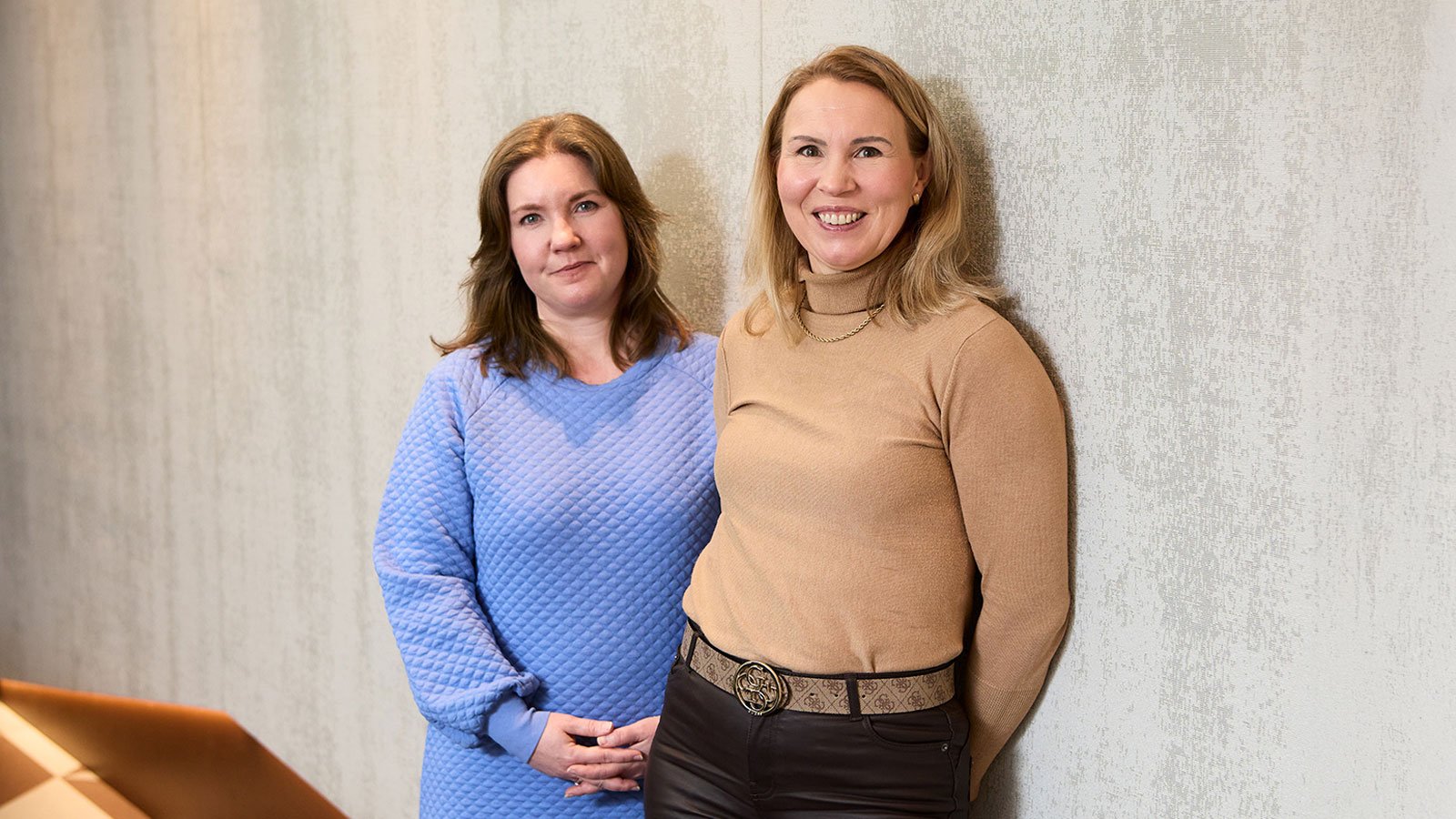
Now all data is available in one place and accessible to everyone who needs it.
A hazy spring morning greets us as we arrive in Herttoniemi. Inside the conference room of Inlook’s carefully designed headquarters, the atmosphere is calm – even as a major digital transformation unfolds in the background. Known as a master of interior construction, Inlook has in recent years taken a systematic approach to modernizing its core business systems.
A few years back, with Efima’s support, the company renewed its ERP on Microsoft Dynamics 365 and introduced Power Apps mobile solutions to support field operations. Now, this shared digital development journey has continued with a comprehensive reporting renewal – with one clear objective: to enable better use of data across the entire organization. The initiative is also closely tied to Inlook’s new strategy. At its core lies a fundamental question – where should the company focus in a rapidly changing business environment?
“Megatrends are shaping the construction industry, and we need to decide where we want to be actively involved – and what we choose to follow from the sidelines,” says Sanna Leskinen, Head of Group Services at Inlook. She emphasizes that all new initiatives – including data and system development – must be aligned with strategic priorities. This need ultimately sparked the decision to modernize reporting tools and practices as well.
Inlook’s previous reporting solution no longer met the company’s current requirements, and renewal was seen as the most straightforward path forward. “We realized that the most agile way to evolve reporting was to move to a completely new, modern solution,” Leskinen explains.
The new environment was built on the Microsoft Fabric platform. “Once you operate within the Microsoft ecosystem, the benefits become obvious. ERP, sales, apps, reporting – everything fits together seamlessly,” Leskinen says, describing the decision to develop Inlook’s IT architecture around a unified ecosystem.
Agile development – one step at a time
The reporting transformation kicked off at the beginning of 2024. The first step was to build a pilot report on Fabric and test how the new technology would serve Inlook’s needs. Once the pilot delivered encouraging results, a longer‑term roadmap was created and the renewal was implemented in phases. “The mindset hasn’t changed – we move forward one piece at a time,” says Erika Nybergh, CFO of Inlook. “If the scope becomes too broad, nothing gets finished. You need a clear plan and prioritization – what we do now, and what we do next.”
Progress was fast. The first Fabric‑based reports were taken into production just a couple of months after the pilot began. Next, Inlook’s most critical reporting areas – finance, projects and sales – were migrated to the new platform. At the same time, entirely new reports and KPIs were developed to better support business decision‑making.
Although the technology was entirely new, everything did not need to start from scratch.
“There’s no need to reinvent what already works,” Leskinen notes. “We migrated certain well‑functioning reports from the old system directly into the new environment, as users were already satisfied with their content.” This ensured continuity during the transition.
At the same time, the new solution enabled further development – including clearer visualizations that allow business users to grasp key figures at a glance.
Data where the business needs it
Leskinen and Nybergh agree on the most significant benefit of the renewal – transparency. “Previously, people pulled data into their own Excel files. Now everything is in one place, and available to everyone who needs it,” Leskinen says, comparing the current state to the past. With a unified IT ecosystem across Finland and Sweden – covering both ERP and reporting – visibility into Inlook’s operations has improved significantly. “A major milestone was bringing our Swedish unit onto the same systems and gaining a holistic view of the entire group,” Nybergh emphasizes.
The impact of the new reporting platform is visible in everyday work through increasing business‑driven requests and ideas. “Business users have noticed that now they can actually see certain insights – and that sparks the next question: ‘Could this also be possible?’” Leskinen says, pleased to see growing interest in data‑driven decision‑making. “This is no longer traditional IT work – this is about meeting real business needs,” Nybergh underlines.
As part of the renewal, greater attention has also been paid to data quality. “Today, you can use enormous amounts of data, but you can also use it incorrectly. You always need to make sure you’re working with the right data,” Nybergh notes, highlighting the importance of data validation. At Inlook, time and effort are invested in verifying that data flowing from ERP into reporting is accurate and reliable – because trustworthy data forms the foundation for sound decisions.
A long‑term partnership built on trust
Over the years, cooperation between Inlook and Efima has evolved into a strong partnership – something that was clearly reflected in the reporting renewal. “Every project has its challenges, and this one was no exception. Not everything goes perfectly, that’s part of the process. With a long‑term partner, difficult situations are easier to solve together,” Leskinen says. “Efima’s experts have come to know us – and we’ve come to know the Efima team. In the end, people work with people, and that mutual understanding is essential.”
A strong partnership also enables constructive challenge. “It’s easy to keep doing things the way they’ve always been done. Here, we wanted to challenge that thinking – how could we use the new solution differently, or present information in a new way?” Nybergh explains. She adds that working with Efima has made this possible. “We’ve been able to test different approaches together and take the time to evaluate whether something is truly useful, or whether it should be done differently.” The implementation also included training and knowledge sharing, ensuring that Inlook’s own teams can further develop reports and build new ones independently in the future.
Looking ahead
Looking forward, Leskinen and Nybergh see predictive capabilities as the next step in reporting. “In the future, we want reporting to look forward, not backward – to actively support decision‑making by anticipating what’s coming,” Nybergh says, describing Inlook’s ambition to leverage data more deeply through predictive analytics. Microsoft’s unified and continuously evolving ecosystem provides a strong foundation for achieving this goal.
At Inlook, new technology is followed with interest – but also with careful consideration.
“Everything is evolving at such a rapid pace. It’s exciting to see where things are headed,” Leskinen reflects. “Maybe someday you’ll just open Power BI and dictate the report you want over your morning coffee,” she adds with a smile. Still, not every innovation needs to be adopted immediately. “You have to choose where you want to be involved – and where it makes sense to wait and observe,” Nybergh adds, emphasizing the importance of focus amidst constant change.
For others considering a reporting and analytics renewal, Leskinen and Nybergh share clear advice based on experience. “Take your time and move step by step. Understand what the new solution makes possible, and define what you actually want from it,” Nybergh says. Leskinen highlights the importance of internal commitment: “This is a development project like any other. Things don’t happen at the push of a button – allocating your own team’s time and resources is critical.” Careful planning, commitment, and realistic expectations ensure the result delivers true business value. “When you put in the effort, the outcome can be really strong,” Nybergh concludes.
Could we help you too?
You can contact us via the form below.